Skip to main content This document provides an overview of Infisical’s cloud architecture for our US and EU deployments, detailing the core components and how they interact to provide security and infrastructure services.
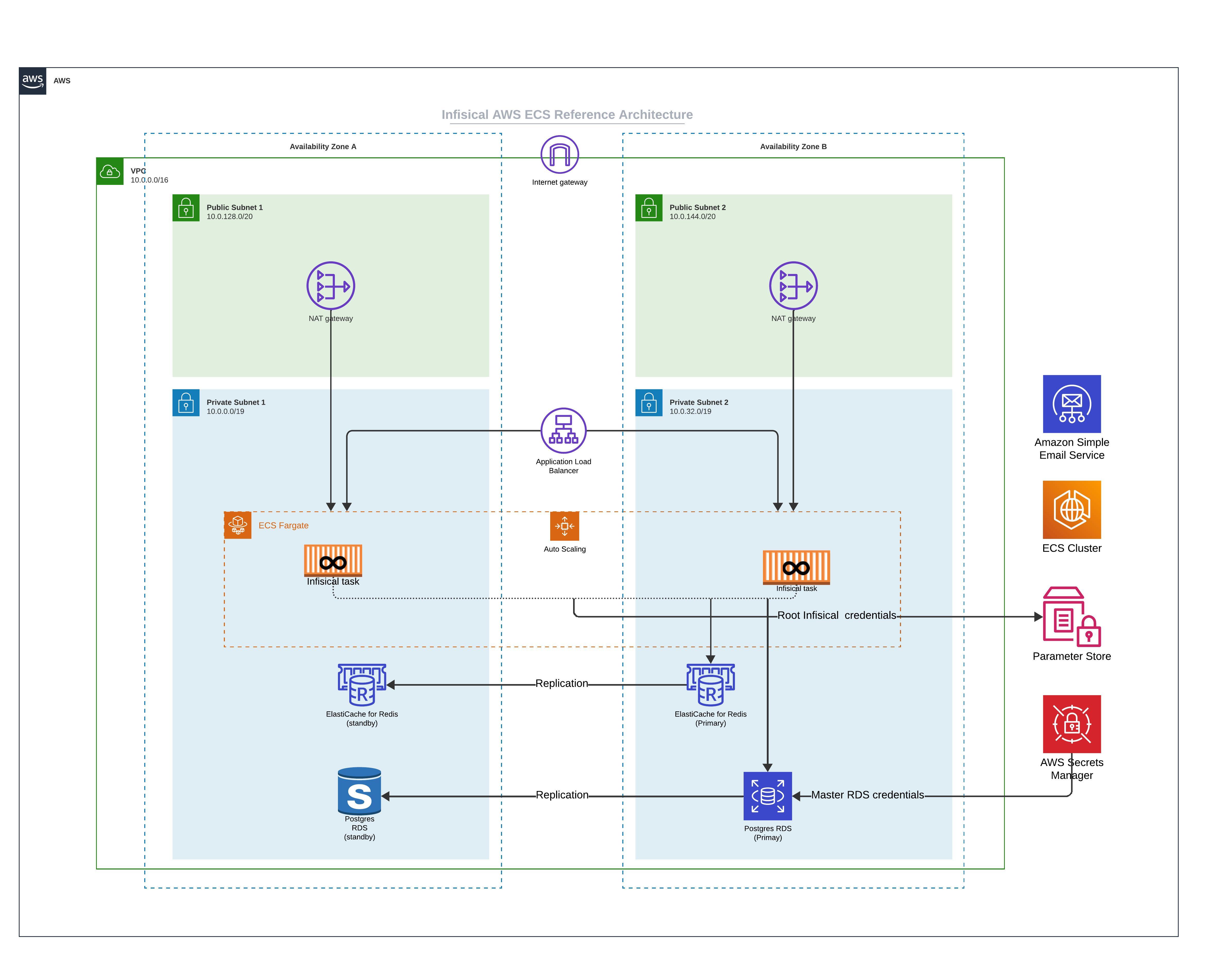
Overview Infisical Cloud operates on AWS infrastructure using containerized services deployed via Amazon ECS (Elastic Container Service). Our US and EU deployments use identical architectural patterns to ensure consistency and reliability across regions.
Components A typical Infisical Cloud deployment consists of the following components:
Application Services
Infisical Core : Main application server running the Infisical backend APILicense API : Dedicated API service for license management with separate RDS instance (shared between US/EU)Application Load Balancer : Routes incoming traffic to application containers with SSL termination and host-based routing
Data Layer
Amazon RDS (PostgreSQL) :
Main RDS Instance : Primary database for secrets, users, and metadata (Multi-AZ, encryption enabled)License API RDS Instance : Dedicated database for license management services
Amazon ElastiCache (Redis) :
Main Redis Cluster : Multi-AZ replication group for core application caching and queuingLicense API Redis : Dedicated cache for license servicesRedis 7 engine with CloudWatch logging and snapshot backups
Infrastructure
ECS Fargate : Serverless container platform running application servicesAWS Global Accelerator : Global traffic routing and performance optimizationCloudflare : DNS management and routingAWS SSM Parameter Store : Stores application configuration and secretsCloudWatch : Centralized logging and monitoring
System Layout Service Architecture The Infisical application runs as multiple containerized services on ECS:
Main Server : Auto-scaling containerized application servicesLicense API : Dedicated service with separate infrastructure (shared globally)Monitoring : AWS OTel Collector and Datadog Agent sidecars
Container images are pulled from Docker Hub and managed via GitHub Actions for deployments.
Network Configuration Services are deployed in private subnets with the following connectivity:
External traffic → Application Load Balancer → ECS Services
Main server exposes port 8080
License API exposes port 4000 (portal.infisical.com, license.infisical.com)
Service-to-service communication via AWS Service Connect
Data Flow
DNS resolution via Cloudflare routes traffic to AWS Global AcceleratorGlobal Accelerator optimizes routing to the nearest AWS regionClient requests are routed through the Application Load Balancer to ECS containersApplication logic processes requests in the Infisical Core serviceData persistence occurs via encrypted connections to RDSCaching utilizes ElastiCache for performance optimizationConfiguration is retrieved from AWS SSM Parameter Store
Regional Deployments Each region operates in a separate AWS account, providing strong isolation boundaries for security, compliance, and operational independence.
AWS Account : Dedicated US AWS accountInfrastructure : ECS-based containerized deploymentMonitoring : Integrated with Datadog for observability and security monitoring
EU Cloud (eu.infisical.com)
AWS Account : Dedicated EU AWS accountInfrastructure : ECS-based containerized deploymentMonitoring : Integrated with Datadog for observability and security monitoring
Configuration Management Application configuration and secrets are managed through AWS SSM Parameter Store, with deployment automation handled via GitHub Actions.
Monitoring and Observability Logging
CloudWatch : 365-day retention for application logsHealth Checks : HTTP endpoint monitoring for service health
Metrics
AWS OTel Collector : Prometheus metrics collectionDatadog Agent : Application performance monitoring and infrastructure metrics
Container Management
Images : infisical/staging_infisical and infisical/license-api from Docker HubDeployment : Automated via GitHub Actions updating SSM parameter for image tagsRegistry Access : Docker Hub credentials stored in AWS Secrets ManagerPlatform : ECS Fargate serverless container platform
Security Overview Data Protection
Encryption : All secrets encrypted at rest and in transitNetwork Isolation : Services deployed in private subnets with controlled accessAuthentication : API tokens and service accounts for secure accessAudit Logging : Comprehensive audit trails for all secret operations
Network Architecture
VPC Design : Dedicated VPC with public and private subnets across multiple Availability ZonesNAT Gateway : Controlled outbound connectivity from private subnetsLoad Balancing : Application Load Balancer with SSL termination and health checksSecurity Groups : Restrictive firewall rules and controlled network accessHigh Availability : Multi-AZ deployment with automatic failoverNetwork Monitoring : VPC Flow Logs with 365-day retention for traffic analysis